
In a stunning confrontation at Oxford University, a young student promoting Islam was left speechless after being aggressively dismantled by renowned commentator Douglas Murray. His piercing critique 𝓮𝔁𝓹𝓸𝓼𝓮𝓭 uncomfortable truths about Islam’s texts, Sharia law, and Western liberalism, delivering a scathing rebuke that reverberated through the academic hall.
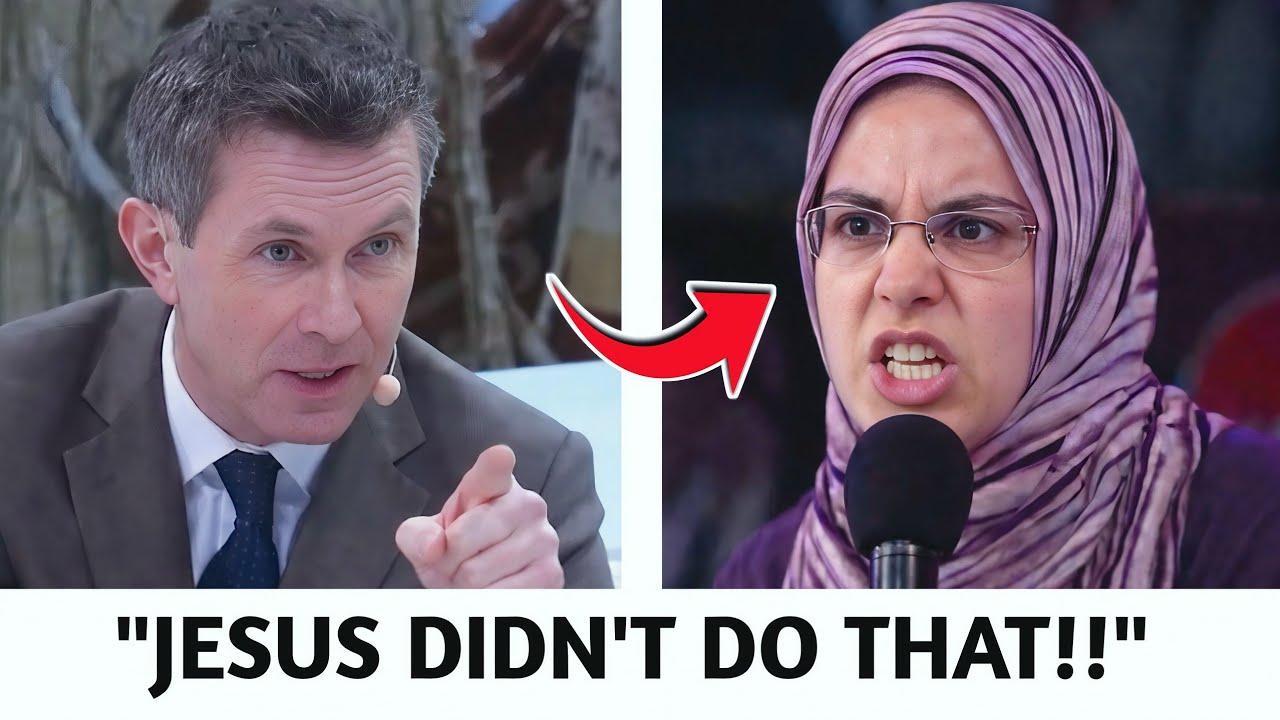 The highly charged debate rapidly spiraled into a masterclass showdown as Murray dissected Islam into three stark realities: its original texts, the body of Sharia law, and the lived experience of Muslims today. The student, armed only with standard academic rhetoric, struggled as Murray crippled her arguments with facts and polling figures revealing widespread support for extremist views within Britain’s Muslim community.
Murray faced down idealistic narratives, pointing out how nearly half of British Muslims sympathize with Hamas and 40% support implementing Sharia law in parts of the UK. The room grew tense as the student’s defense of “lived Islam” as a peaceful coexistence crumbled under the weight of hard data and uncomfortable polling results.
The commentator escalated his attack, highlighting the stark contrast between the legacies of Muhammad and Jesus. Unlike the pacifist teachings of Jesus, Murray reminded the audience that Muhammad led and sanctioned more than 80 military campaigns, directly tying acts of violence to Islam’s foundational history—a fact the student could not counter.
When colonialism was raised as a defense, Murray swiftly dismantled it, exposing historical double standards. He demanded why only Western nations are expected to apologize for imperial actions while the Ottoman Empire’s brutal centuries-long slave trade remains unacknowledged. The student’s silence spoke volumes as the narrative she clung to was laid bare as selective and politically motivated.
Murray did not hold back on social issues either, citing chilling statistics among British Muslims: over half believe homosexuality should be illegal; nearly 40% endorse wives always obeying husbands. These figures sent shockwaves through the hall, confronting the wokeness of the younger generation with the harsh realities faced by many Muslim women under religiously influenced cultural norms.
As the debate intensified, Murray dropped a bombshell, citing the authoritative Sunni Hadith collections prescribing death for homosexuality. This revelation 𝓮𝔁𝓹𝓸𝓼𝓮𝓭 the hypocrisy of progressive students defending doctrines that underpin brutal punishments in countries like Iran and Saudi Arabia. The clash between Western liberal values and unyielding religious law was laid bare.

The young Oxford student’s attempts to salvage the debate with claims of cultural misunderstanding and colonial aftereffects failed repeatedly. Murray’s relentless focus on evidentiary history and contemporary data transformed the exchange into a devastating indictment of Islamist ideology’s incompatibility with Western democracy and liberal freedoms.
Murray concluded with a dire warning, urging society to confront these “combustible” realities rather than accepting comforting myths. He predicted grave consequences if Western nations continue to tolerate parallel legal systems hostile to individual rights. His message resonated as a call to action: the future of liberal democracy hangs in the balance.
This explosive debate 𝓮𝔁𝓹𝓸𝓼𝓮𝓭 a critical schism within academia and society at large—between the ideological defense of Islam and the urgent need for honest discourse grounded in fact. Douglas Murray’s relentless scrutiny has ignited fierce discussions about integration, freedom, and the challenging truths often ignored by institutions and media alike.
The aftermath leaves no doubt: the West faces a crossroads. Will it continue to embrace naive idealism, or will it confront brutal historical and modern truths about the religion it once sought to uncritically defend? The chilling data and Murray’s fearless challenge demand urgent reflection across universities, media, and policymaking circles.
As the dust settles on this watershed moment at Oxford, it is clear that the old narratives of multicultural harmony have been critically undermined. Murray’s relentless exposure of inconvenient realities has shattered illusions, leaving a generation forced to reckon with a complex, fraught coexistence between Western values and Islamic doctrine.
The young student’s meltdown is emblematic of a broader struggle playing out globally—between progressive multiculturalism and the uncompromising truths embedded in religious texts and traditions. Murray’s performance serves as a stark reminder that honesty, not rhetoric, must guide public debate on Islam’s place in Western society.
If this debate signals anything, it is the urgent need for open discourse free from political correctness and suppression of inconvenient facts. The next steps for policymakers and educators will shape not just academic debate, but the fundamental future of liberal democracy in predominantly Western nations facing growing Islamic populations.
Douglas Murray’s argument is not merely academic; it is a profound challenge to Western societies to reject denial and face the consequences of importing values fundamentally at odds with freedom, equality, and human rights. This breaking moment at Oxford is a clarion call to awaken from complacency.
The tension between religion and liberalism 𝓮𝔁𝓹𝓸𝓼𝓮𝓭 here will inevitably intensify as demographic and political shifts continue. Whether Western institutions will adjust to this reality with courage or continue to cling to comforting fantasies remains to be seen. What is evident is that the spotlight Murray shone has irrevocably altered the conversation.
In the aftermath, the demand for transparency and sincerity about Islamic texts and their societal impact has never been more urgent. Murray’s unflinching examination reveals the critical need for open, factual discussions that reject euphemism and confront the real challenges posed by religious doctrines.

As students and academics alike grapple with the fallout, this debate will likely be studied as a pivotal moment where ideology collided with unvarnished reality. Douglas Murray’s relentless pursuit of the truth tore through platitudes, demanding a brutally honest appraisal of Islam’s compatibility with Western democratic values.
The explosive nature of this confrontation underscores the urgency for societies to address these difficult questions head-on. Ignoring the realities documented by polling and history will only deepen divisions. Murray’s devastating critique stands as a warning: liberal democracy’s survival depends on facing these truths without fear or favor.
This high-stakes debate has shattered complacency and 𝓮𝔁𝓹𝓸𝓼𝓮𝓭 fractures in Western tolerance for incompatible ideological systems. The aftershocks will ripple through educational institutions, the media, and political discourse as the West confronts a defining existential challenge.
As Oxford witnessed, ideological buzzwords and academic platitudes fall short against rigorous historical analysis and indisputable statistical evidence. Douglas Murray’s masterclass in debate strategy 𝓮𝔁𝓹𝓸𝓼𝓮𝓭 a dangerous naiveté that threatens society’s core liberties if left unchallenged.
The debate’s raw honesty has ignited passionate discussion, forcing all sides to reconsider their assumptions about cultural integration, religious freedom, and social cohesion. It prompts an urgent reevaluation of how liberal values can be preserved amid ideological currents that openly reject them.
In sum, Douglas Murray’s unrelenting challenge to the Oxford student was a historic crucible revealing the fault lines between Western liberalism and orthodox Islam. The confrontation was not just academic but a stark warning with profound implications for the future of free societies confronting uncompromising religious doctrines.


