
The deceptive tranquility of Coronation Street has been irrevocably incinerated, replaced by a radioactive atmosphere of clinical dread and raw emotional carnage as the “start of the end” for the “twisted teacher” Megan Walsh officially detonates. For months, the Street has watched with “suffocating, low-level dread” as Megan—a predator who “spots the weakness in her victims” with a “clinical masterclass” in manipulation—systematically dismantled the lives of Will Driscoll and the precocious Sam Blakeman. While the rest of Weatherfield saw an “upstanding educational force of good” who swept Daniel Osbourne off his feet, Sam saw through the “perfectly manicured veneer” to the “predatory pedophile” beneath. In a visceral “surgical reckoning,” Megan unleashed a “crusade of terror” against the youngster, “sabotaging his grades” and “stripping away his identity” until the pressure cooker of his “studious world” suffered a terminal structural failure. The atmospheric dread is absolute; as Sam was driven to use “ADHD drugs” to cope with her “ruthless picking apart” of his armor, his body eventually rebelled, leading to a “shock collapse” on the cobbles that moved the narrative to a “terminal point of impact” for the entire Battersby-Price clan.
The dramatic genius of this “unforgettable chapter” lies in the “deliberate and calculated” way Megan “weaponized Sam’s own prying intelligence” against him, turning his attempt to “plant a camera” into a “psychological cage” of gaslighting. In a “staggering and strategic” flex of power, Megan orchestrated a performance where Will “confessed his love” only for her to “kindly turn him down” for the recording, framing Sam as a “creepy, perverted voyeur.” This “systemic emotional erosion” left Sam “drifting” in a sea of paranoia, even after a “terminal confession” to Leanne Battersby led to a “surgical strike” by the auth
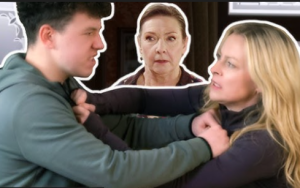
orities. However, the “quite chilling” reality is that the “Undertaker of Truth” has left behind “grizzly scars”; though Megan has been “reported and confronted,” Sam remains “bombarded and crippled” by “visual and auditory hallucinations.” Every shadow on the Street now presents a “lethal ultimatum” to his safety, as he “imagines Will preparing to attack” or hears “threats from the digital shadows,” suggesting that “truth once uncovered doesn’t protect you—it exposes you” to a “terminal madness” that could lead to a “murderous discovery.”
While Sam “struggles in the fate” of his deteriorating mental health, the “moral landscape” of the Street is being “permanently reshaped” by the “Who Done It” mystery currently “cataracting the road.” Megan Walsh has “created her own demise” in poor Sam, becoming a prime seeker for the “upcoming death” alongside other “villainous roles” like Theo Silverton and Carl Webster. The “extraordinary emotional weight” of the mystery suggests that the “unexpected killer” may not be a figure of “single-moment rage,” but rather a “carefully constructed chain of events” involving a child pushed “beyond his absolute limit.” If Sam’s “terminal hallucinations” drive him to “end his tormentor,” the “ripple effects” will leave the community in a “state of total psychological collapse,” forcing a “heart-wrenching choice” between justice and the “fragility of youth.” This isn’t just a “slow-burning drama”; it is a “lethal reckoning” where “ordinary behavior takes on a far more sinister meaning,” and the “quiet moments in the aftermath” of a child’s “accidental vision” could “summarily incinerate” the future of the Battersby family.
The “atmospheric dread” of the investigation is “thick enough to cut with a knife,” as “red herrings” are “scattered throughout the narrative” to distract from the “hidden villain in plain sight.” Almost every resident connected to Megan has a “lethal motive,” from Ben Driscoll’s “fiery protection” to Eva Price’s “vicious and visceral” rage. Yet, the “quite final” horror currently “flooding social media” is the realization that the “real answer” may be hidden in the “quieter, more understated moments” of Sam’s “terminal paranoia.” As Hope Stape “whispers poisonous suggestions” that others are “still in cahoots with Megan,” the “seismic rift” of suspicion turns “former friends into suspicious enemies.” This “high-stakes psychological war” proves that in Weatherfield, “guilt spreads faster than truth,” and the “clinking of silverware” at any dinner table could be silenced by the “explosive revelation” of a “pint-sized killer” who finally “took back the power” in the most “final and irreversible way possible.”

As the clock ticks toward the next “unforgettable heartbeat” of the story, the only certainty is that the “nation’s favorite soap” has officially run out of road for “neat and manageable resolutions.” Megan’s “vicious torture” of a child has “permanently reshaped” the historic cobbles, turning a “studious boy” into a “biological bomb” of trauma. Whether the “terminal point of impact” is a “tragic accident” or a “calculated act of survival,” the “Wedding Day Massacre” of Sam’s innocence is complete. We, the audience, are left “breathless and shattered,” realizing that the “end of Megan Walsh’s reign” is almost always the beginning of something “infinitely, irreversibly worse” for those she leaves behind. Stay close, watch carefully, and don’t blink—because the “truth rarely stays buried for long” in Weatherfield, and once the “smoke clears” from the “murderous discovery,” the “scars, both physical and emotional,” will remain as a “harsh, unrelenting reality” until the very last credit rolls.


